Ossigeno e velocità del flusso I read, recently, an article by Dr. Ole Pedersen, known associate of Tropica, entitled "Flow velocity Affects Internal Oxygen Conditions in the seagrass Cymodocea nodosa and available on their website
. This study was carried out on a marine macrophyte but in the author's considerations also apply to freshwater macrophytes with roots.
The premise is that the macrophytes usually grow on anoxic sediments and the transport of oxygen from leaves to roots (and their radial dispersion) are needed to support aerobic metabolism and prevent the invasion of toxic substances from the sediment. During the daytime oxygen production is usually sufficient, but during the night can decline to the point that cause the plant in sofferenza.In quick study shows that under certain flow rate of water transport oxygen from leaves to roots decreases drastically.
This made me realize that the concerns that certain substrates determine anoxic zones is unfounded as this condition can be seen to be common to all funds. Moreover, whatever the fund an adequate oxygen saturation and an adequate flow velocity (around foliar apparatus) induce a release of O2 by the roots enough to oxygenate the substrate.
I asked on the forum
Aquagarden if anyone had had experience in the aquarium to support of these theories. The responses were almost all favorable because:
- the introduction of pumps movement in all cases beneficial to the development of plants with immediate answers
- the presence of anoxic zones is not considered problem is in fact correctly attributed to them the conversion feature of waste substances in nutrient
However no one seems to have benefited from the introduction of oxygen through aerator, recommended among other things by Takashi Amano for the night phase of the photoperiod. It can be hypothesized that the lack of results might be due to the following factors:
- The amount of dissolved oxygen already close to saturation level in the aquarium in question.
- Low efficiency aerator with the benefits of the introduction of oxygen from the HF dispersion of CO2 due to increased water movement.
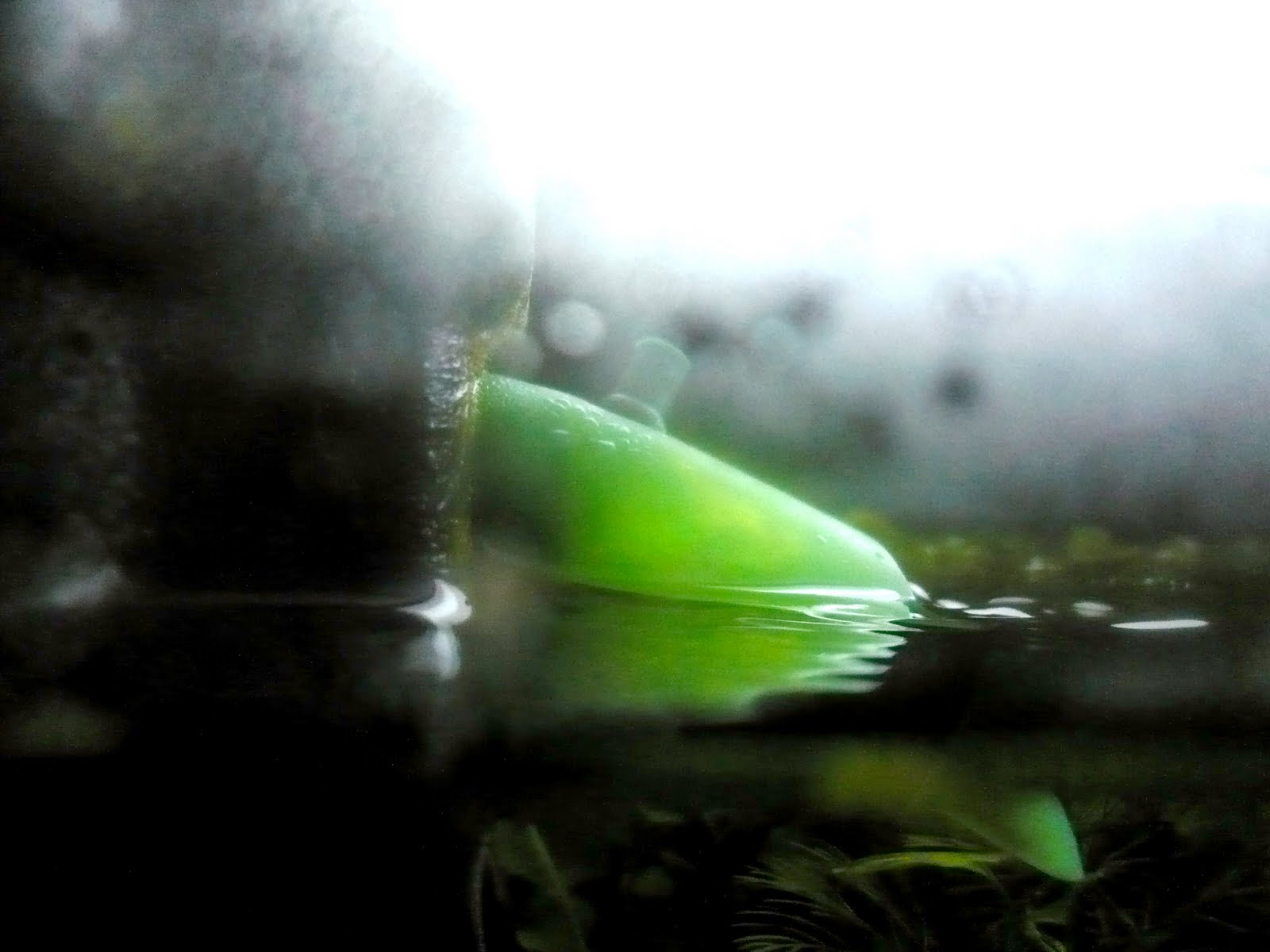
Facing the problem of summer heat with its decreasing concentration of oxygen in the tank I wanted to run tests by slightly changing the pump system: through regulator I increased the hourly flow and I applied a rubber tube on output (as in the photo) truncated obliquely so as to bring the ends under the water surface. This reduces the movement of surface and prevents loss of CO2.

Also on the top of this tube I have grafted a forza un tubo più piccolo leggermente inclinato. Questo tubo, sfruttando il minimo di effetto venturi presente, introduce dell'ossigeno nel flusso d'acqua.

Chiaramente il solo aumento della portata, che oltretutto verrà man mano ridotto dall'intasamento del materiale filtrante, non può portare gli stessi benefici di una pompa di movimento ma dovrebbe comunque migliorare la situazione.
 There is much talk of Napoleon in recent weeks.